What Honda's A67 maintenance code covers and how to compare quotes for it
Honda’s Maintenance Minder shows a code rather than a service list. When it displayed A67 on a CR-V I was planning an appointment for, I had a dashboard string, no itemized scope, and a service advisor waiting on an answer. I wrote Vehicle Maintenance Planner afterward, because the part I got wrong was preparation rather than arithmetic.
This post covers the three things worth settling before you hand over the keys: what A67 actually covers, what a written estimate has to contain before two prices can be compared at all, and how to decide whether a cheaper quote is worth a second trip.
What A67 covers
Honda combines one main item with zero or more numbered sub-items, concatenated without
separators. The manual’s own illustration shows a display reading A12345, so in A67 the letter
and both digits each carry a separate instruction. The 2024 CR-V Maintenance Minder
tables
define them as:
| Code | Honda-defined scope |
|---|---|
| A | Replace engine oil |
| 6 | Replace rear differential fluid (marked “not available on all models”) |
| 7 | Replace brake fluid |
The gap between A and B is the one that costs people money. Code A names engine oil by itself. Code B is engine oil and the oil filter, plus a brake inspection and a list of other checks covering tie rod ends, steering gearbox and boots, suspension components, driveshaft boots, brake hoses and lines, fluid levels, the exhaust system, and fuel lines. Honda’s own capacity table makes the distinction concrete: 3.4 US qt for a change, 3.7 US qt including the filter. Plenty of shops replace the filter during an A service regardless, which is their practice rather than Honda’s requirement. Either is fine as long as the estimate says which one you are buying.
Item 7 is the one that surprises owners with low mileage. Honda ties it to elapsed time as well as use. The footnote reads that if a Maintenance Minder message does not appear more than 36 months after the display for item 7 is reset, you change the brake fluid every 3 years. That wording matters, and it is worth quoting exactly, because the widespread paraphrase (“item 7 appears every three years regardless of mileage”) describes a different rule.
Two smaller notes. If your CR-V is the hybrid, use the hybrid manual: its code tables differ from
the gas car’s in both the B-item list and the transmission-fluid interval. And a code you see on
the dash is more often A167 than A67, because item 1 is a tire rotation on a short cycle that
usually comes due at the same visit. Each sub-item resets independently, so plain A67 is
well-formed, just less common.
The code’s origin is worth writing down too. An item the vehicle displayed, a recommendation added at the counter, and something you asked for yourself are three different things, and by the time you are reading an invoice they look identical. The planner keeps them apart, and it carries the manual citation and retrieval date on every rule it applies:
$ vehicle-maint explain-code A67 --json
{
  "displayed_code": "A67",
  "origin": "vehicle_displayed",
  "assessments": [
    {
      "code": "A",
      "state": "due_now",
      "reason": "The vehicle displayed this Maintenance Minder code.",
      "rule": {
        "code": "A",
        "title": "Replace engine oil",
        "market": "US",
        "model_applicability": "2024 Honda CR-V Sport-L Hybrid AWD",
        "source_url": "https://techinfo.honda.com/...",
        "retrieved_date": "2026-08-15",
        "time_fallback_months": 12,
        "time_fallback_note": "If the message does not appear within 12 months after reset, replace the oil annually."
      }
    },
    ...
    {
      "code": "7",
      "state": "due_now",
      "rule": {
        "title": "Replace brake fluid",
        "time_fallback_months": 36,
        "time_fallback_note": "If the message does not appear, Honda specifies replacement every three years."
      }
    }
  ]
}
The catalog that ships with the project is scoped to the CR-V hybrid, which is why the model line
reads the way it does. The time_fallback_months field is the part I care about most: the
three-year brake-fluid rule and the twelve-month oil rule survive as data rather than as something
you have to remember at the counter.
Make the estimates comparable before you rank them
A price only means something attached to a scope. Before comparing two written estimates, confirm they answer the same questions:
| Comparison field | Required information |
|---|---|
| Service scope | A, 6, and 7 are each included |
| Fluids and parts | Specifications and quantities are identified |
| Labor | Labor is included and separately described when practical |
| Fees and tax | Supplies, disposal fees, and tax treatment are stated |
| Warranty | Coverage and exclusions are written down |
| Duration | Expected appointment time is provided |
| Total | The out-the-door amount is unambiguous |
A lower number for different work is a different purchase. The same goes for an estimate that omits fees, specifies a different fluid, or leaves the warranty vague. Those gaps need a phone call before the prices go side by side.
One shortcut is worth the trouble here: price-check the largest line first. On a multi-service bundle like A67 the spread between shops concentrates in one or two items, and getting a comparison price on the biggest line captures most of the available savings for one phone call. The line I most needed a second price on was the one I had no second price for.
Put a value on a second trip
Suppose the cheaper estimate requires its own appointment. The question becomes whether the saving covers the trip. The calculation is one division:
maximum extra-trip hours = price difference / value of one hourPublished component estimates for the three A67 services land somewhere around $440 to $620 nationally before tax and fees, so take $620 and $440 as round illustrative figures with a $180 difference. They are stand-ins for your own written quotes, not a benchmark for what this should cost.
| Value assigned to an hour | Break-even extra-trip time |
|---|---|
| $50/hour | 3.6 hours |
| $100/hour | 1.8 hours |
| $150/hour | 1.2 hours |
If the second appointment costs 1.5 hours beyond the single visit the more expensive shop would have required, the cheaper option keeps $105 at $50 per hour and $30 at $100 per hour. At $150 per hour the extra time costs $45 more than the price difference buys back. The answer moves with your own hourly value instead of hiding that assumption inside somebody’s recommendation.
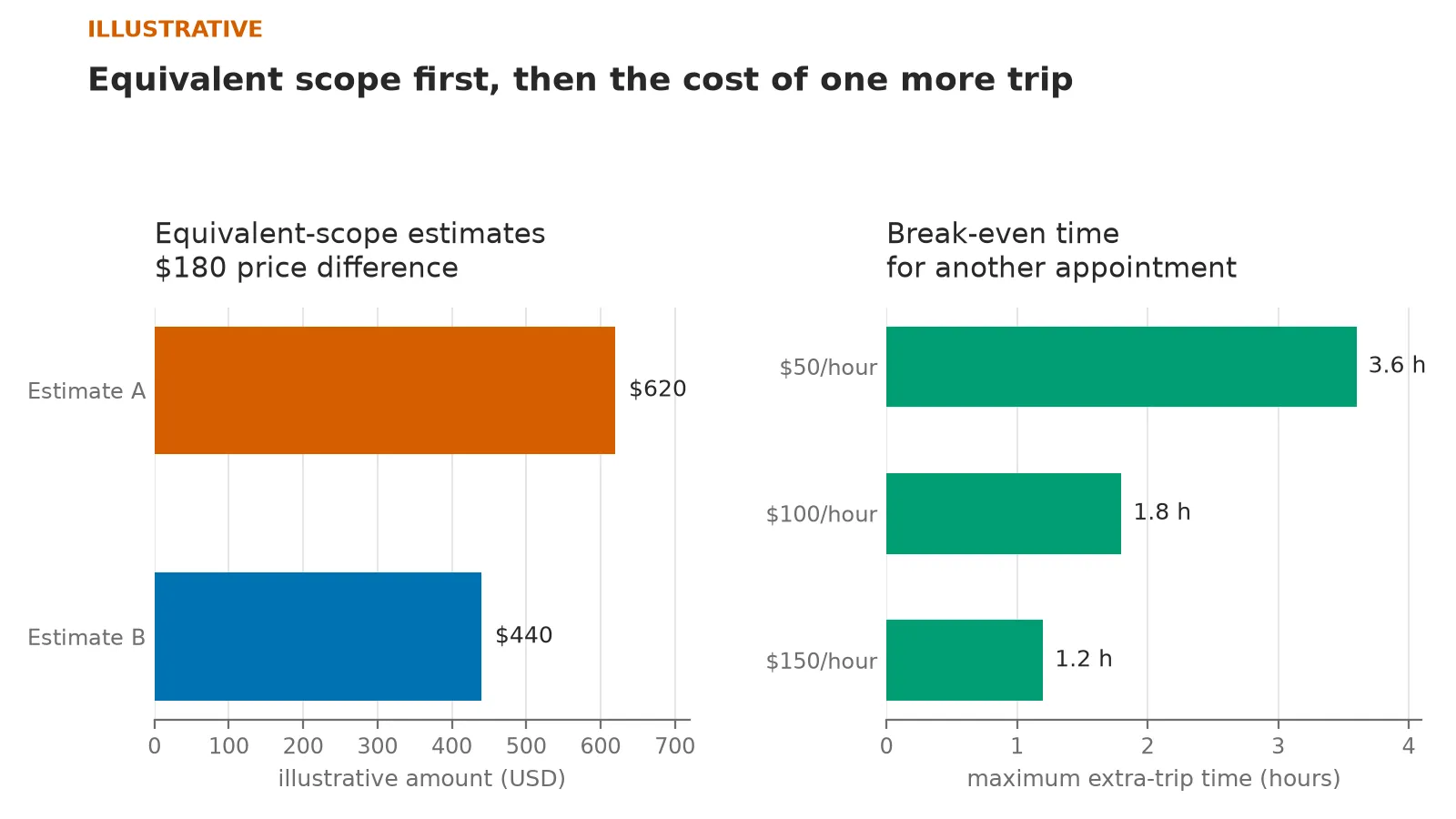
Illustrative equivalent-scope estimates and the break-even extra-trip time they imply. The figure generator checks the difference and each break-even result before drawing the chart.
Two caveats on the arithmetic. It measures the extra hours relative to the single visit the pricier shop would have needed, so a second trip that replaces a first trip is not “extra” at all. And time is not the only cost of the cheaper option: fuel and mileage for the additional drive belong in the same subtraction. Neither changes the shape of the answer, and both change where the line falls.
The break-even number also settles a narrow question. Confidence in the written scope, warranty terms, whether a shop has seen your car before, and anything touching brakes can outrank the arithmetic. All the calculation tells you is how much additional time would consume the stated price advantage.
Your state may guarantee a written estimate
Consumer-protection statutes often cover exactly this transaction, and the rules are usually easier to invoke than owners expect. Washington is one example: the state Attorney General’s auto-repair guidance says you are entitled to a written price estimate for face-to-face repairs expected to cost more than $100 unless you waive it, and that a facility “may not charge you more than 10% above the estimated costs without your prior approval.”
Check your own state’s version. A written estimate you already have a right to is the cheapest input to every comparison above.
The workflow
The useful moment is when the code first appears, while you still have time to call other shops:
- Record the displayed code and confirm it against the manual for your year, market, and drivetrain.
- Turn the code into identical written scope text for each candidate shop.
- Collect current written estimates from a mix of dealers and independent specialists, and get at least one on the largest line.
- Clarify missing fluids, parts, labor, fees, warranty, duration, or totals.
- Calculate the extra-trip threshold before you drop the car off.
Step 2 is the tedious one, and it is the step the planner exists for. Given a plan, quote packet
emits the request text to send each shop, already asking for every field in the comparison table
above:
$ vehicle-maint plan create --codes A67 --odometer 32000 --json
$ vehicle-maint quote packet --plan ACTIVE --json
{
  "plan_id": "plan-20260817-092a2d28",
  "required_provider_mix": {"dealer": 2, "specialist": 3, "within_miles": 30},
  "provider_count": 0,
  "complete": false,
  "template_for_unfilled_slots": "Please provide a written, itemized quote for
    U.S. 2024 Honda CR-V Sport-L Hybrid AWD at 32,000 miles.

    Requested Maintenance Minder scope: A67
    - A: Replace engine oil
    - 6: Replace rear differential fluid
    - 7: Replace brake fluid

    Please state:
    - exact fluid and parts specifications and quantities;
    - labor, parts, shop/environmental fees, tax, and out-the-door total;
    - whether any listed service is bundled with other work;
    - parts and labor warranty;
    - estimated appointment duration; and
    - relevant Honda and hybrid experience.

    Do not add work beyond this scope without listing it separately and
    explaining why it is due."
}
That text is the whole point. Sending the same scope to five shops is what makes their numbers
comparable, and writing it five times by hand is why most people skip it. complete: false tracks
how many replies are still outstanding against the provider mix, so partial results do not get
ranked as if they were finished.
The break-even step takes the two totals:
$ vehicle-maint decision break-even --dealer-cents 62000 --alternative-cents 44000 --json
{
  "savings_cents": 18000,
  "break_even_hours": {"$50/hour": 3.6, "$100/hour": 1.8, "$150/hour": 1.2},
  "explanation": "The alternative saves money before valuing another appointment;
    the hours are the maximum additional trip time that preserves those savings."
}
The --dealer-cents flag is named for the common case and carries no claim about who quoted what;
either side can be any shop. Everything runs locally against a SQLite database you own. The
application performs deterministic comparisons without contacting a provider or acting on the
result. Shop contact, booking, and authorization stay with you.
What this gets you
Equivalent written scope is a prerequisite for comparing prices at all, and a cheaper estimate can be weighed against the cost of another appointment instead of guessed at. None of it establishes what A67 should cost in your market or whether a particular recommendation is necessary. Those need current written quotes and a mechanic.
Personal service documents, quotes, vehicle identifiers, and authorization records stay in a private application-data directory outside the repository. Source, synthetic fixtures, privacy rules, and release gates are in the Vehicle Maintenance Planner repository.
Vehicle Maintenance Planner is an organizational and arithmetic-support tool. It is not mechanical, legal, or safety advice. Confirm service needs against the correct owner’s manual and a qualified professional, and confirm state repair rules against your own state’s guidance.
This is an independent project I build on my own time, and it is unaffiliated with Honda, vehicle dealers, and repair shops. The views are my own and do not represent any current or former employer.
Frequently asked questions
What does code A67 mean on a Honda CR-V?
Honda defines A as engine-oil replacement, 6 as rear-differential-fluid replacement, and 7 as brake-fluid replacement. Item 6 is marked not available on all models and applies to drivetrains that have a rear differential. Check the Maintenance Minder table in the manual for your model year, market, and drivetrain.
Does Honda code A include an oil-filter replacement?
No. Honda lists engine oil alone under main code A. The oil filter appears under main code B, along with a brake inspection and a list of other checks. Many shops replace the filter during an A service anyway, which is dealer practice rather than a Honda requirement, so a written estimate should say which one you are buying.
Why is brake fluid due at low mileage?
Honda ties item 7 to elapsed time as well as use. The manual's footnote reads that if a Maintenance Minder message does not appear more than 36 months after the display for item 7 is reset, you should change the brake fluid every 3 years. A low odometer reading does not postpone that.
When are two maintenance estimates comparable?
They should cover the same services, fluid and parts specifications, labor, fees, tax treatment, warranty, expected duration, and out-the-door total. Clarify anything missing before you rank the prices.
How does the extra-trip break-even calculation work?
Divide the price difference by what you decide an hour of your time is worth. The result is how much additional travel and appointment time the cheaper option can absorb before its price advantage is gone.
More in Side projects
- slopscore 0.9.0 adds a dimension for manufactured sincerity · 2026-08-03
- Gumline, a private dental habit tracker · 2026-07-09
- slopscore: a transparent linter for AI-slop writing patterns · 2026-06-25