The antenna is the modulator: index modulation with reconfigurable metasurfaces
A conventional radio transmitter is a chain of parts: a source, a mixer to move the signal up to the carrier frequency, phase shifters and amplifiers, and an antenna at the end that radiates whatever the chain produced. Our JSTSP 2023 paper takes a different route: the antenna becomes the modulator. A programmable metasurface, reconfigured fast enough, imprints the information onto the wave itself and does away with much of the RF chain.
The paper (with Kumar Vijay Mishra, Brian Sadler, and Amir Zaghloul) designs reconfigurable intelligent surfaces (RIS) that carry out index modulation for 6G, and grounds the designs in full-wave electromagnetics. This post is the plain-language version. It sits alongside the rest of my metasurface work on the research page.
Bits in the indices
Most modulation encodes bits in a carrier’s amplitude and phase, a QAM constellation being the familiar example. Index modulation adds another place to put information: the index of which resource is active. Turn on antenna 3 out of 8, and the choice of “3” carries bits by itself. The active resource can be an antenna or beam (spatial), a frequency subcarrier or harmonic (frequency), a time slot (temporal), or a channel state (channel). Because the selection costs almost nothing in power, index modulation can raise both spectral and energy efficiency, which is what 6G is asking for.
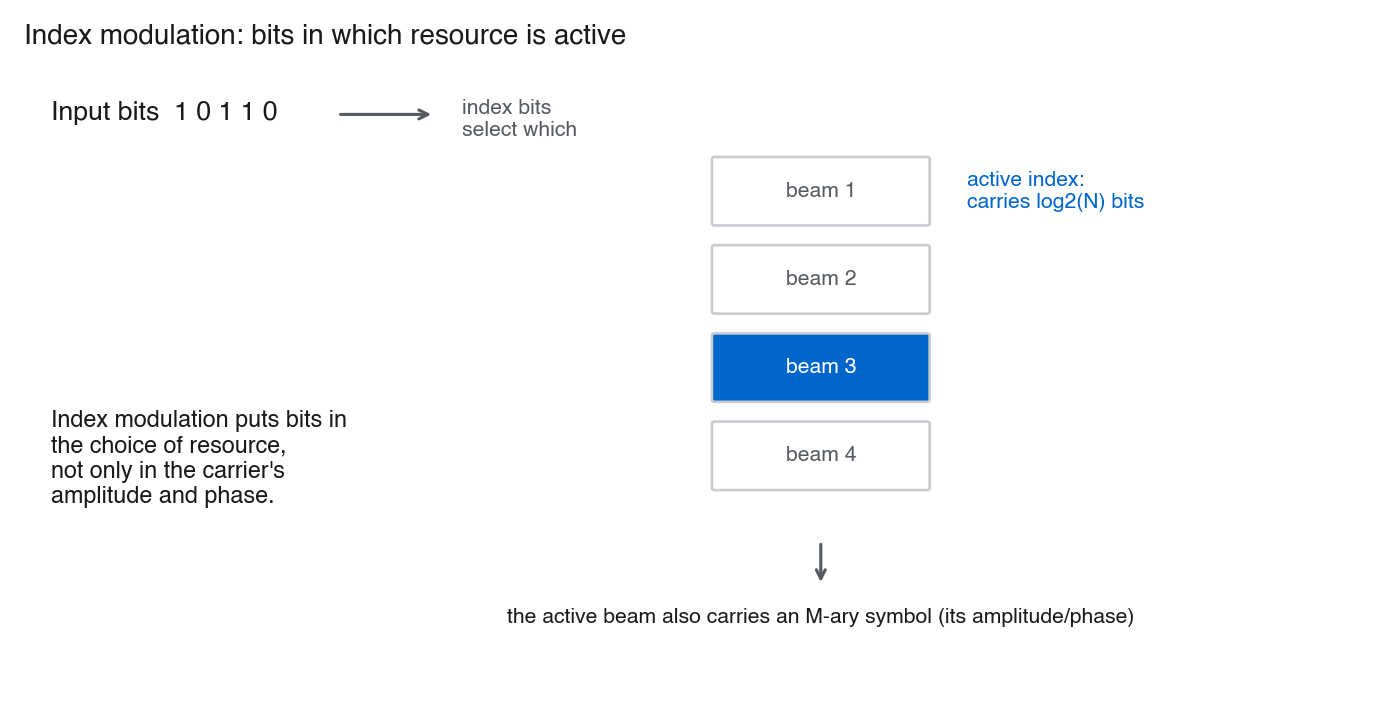
Index modulation puts bits in the choice of resource. Here the index bits pick which beam is on, and the active beam also carries an ordinary M-ary symbol.
A metasurface as a programmable aperture
The surface that does this is a reconfigurable metasurface: a flat array of subwavelength elements (“meta-atoms”), each with a tunable element (a varactor diode) that sets its reflection phase. Put an RF feed in front of it and the surface works as a reflectarray, reshaping the reflected wave. By choosing the phase of each element you can steer a beam, form several beams, or modulate the signal, all without the mixers, phase shifters, and power amplifiers of a conventional front-end. The paper works through how to realize each family of index modulation on such a surface.
Which beam is on
The spatial version is the easiest to picture. A phase gradient across the surface steers the reflected beam to a chosen angle, following the generalized law of reflection. Split the aperture into sub-apertures and you can point several beams at once. Spatial index modulation encodes bits in which sub-aperture, or which beam direction, is active at a given instant.
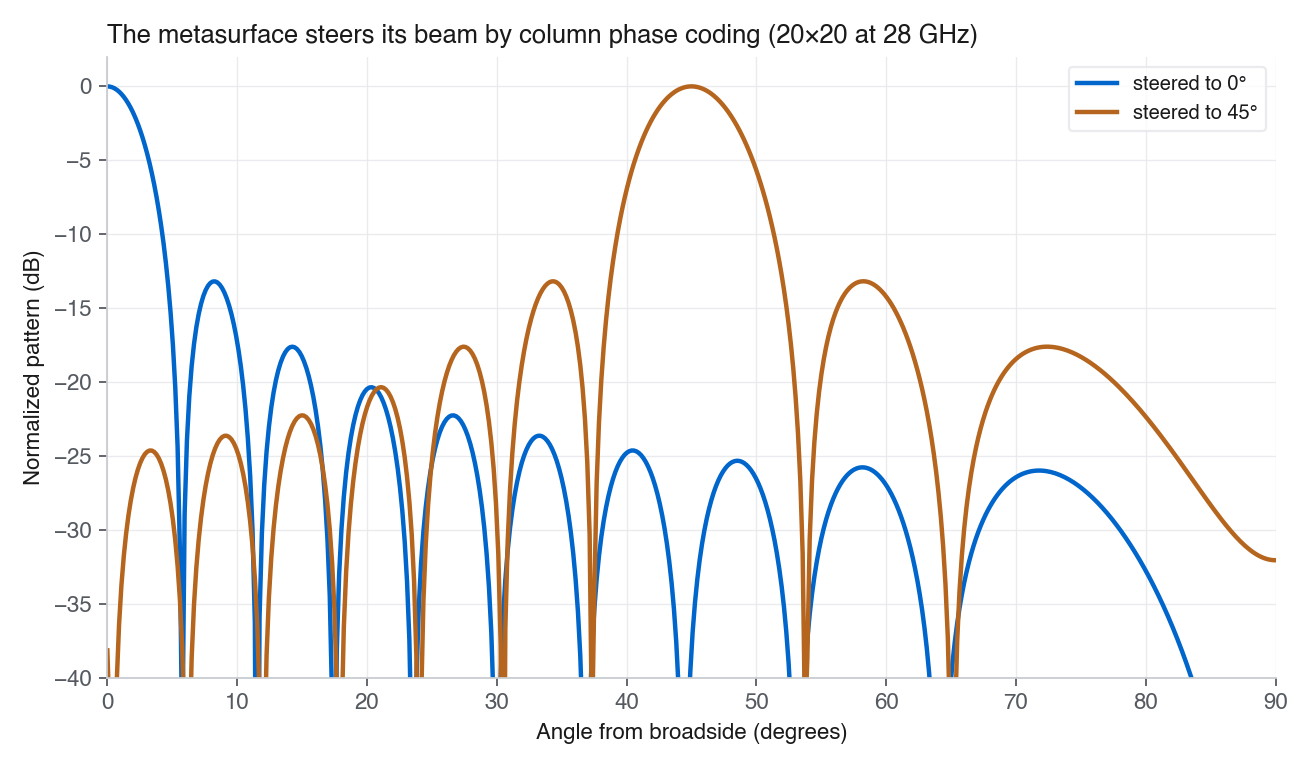
A 20-by-20 element surface at 28 GHz steered to broadside and to 45 degrees, computed with my open-source metasurface-py package. Which beam is on is the transmitted index.
Making harmonics with time
The frequency version is the one I find most surprising. If you vary a meta-atom’s reflection phase over time, the reflected wave picks up frequency harmonics at fc + m·f0, where f0 is the modulation rate. The slope of the time-varying phase code sets which harmonic, m, carries the energy. The surface behaves like a mixer: it moves the carrier to a chosen subcarrier with no actual mixer in the circuit. Frequency-domain index modulation then encodes bits in which harmonic is switched on.
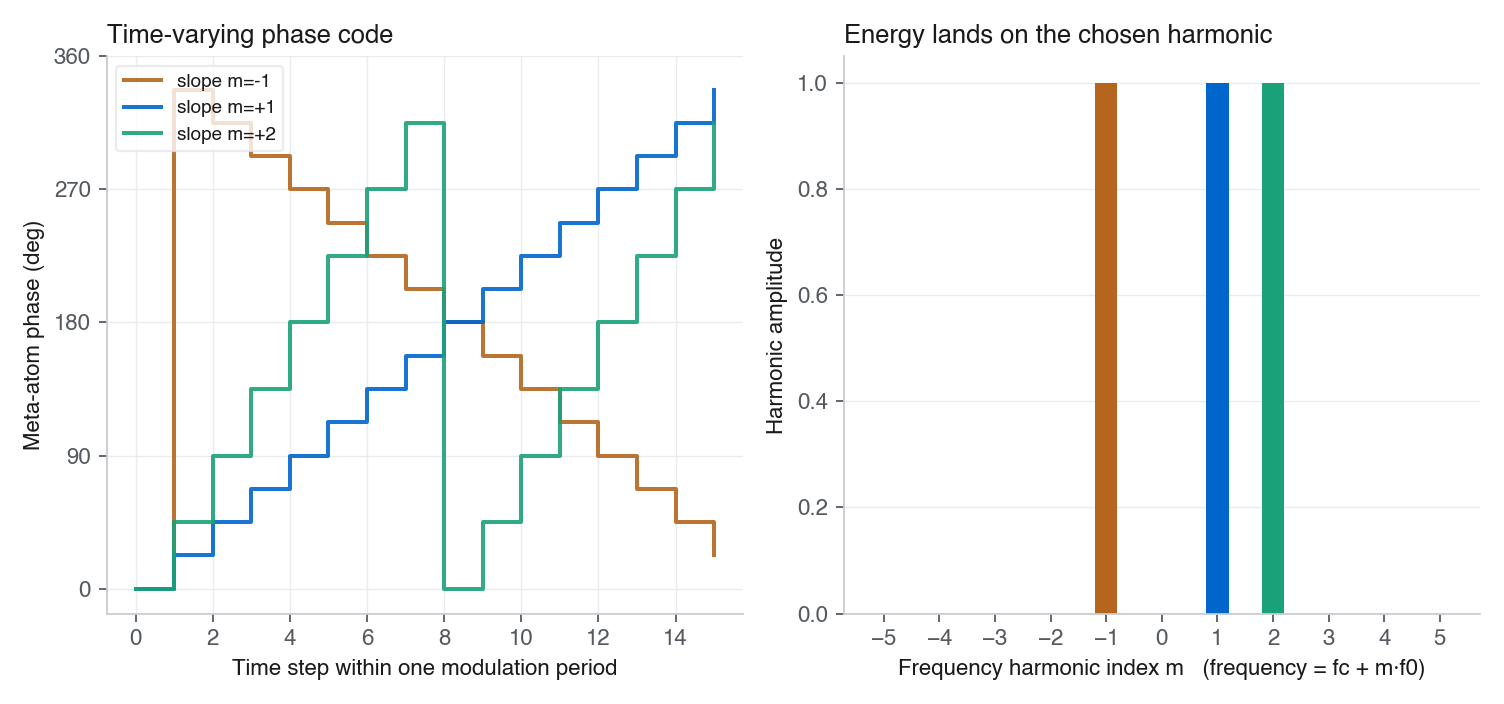
A time-varying phase code across the meta-atom (left) shifts the reflected energy onto a chosen frequency harmonic fc + m·f0 (right). The slope of the code selects the harmonic index m.
A circular shift of the same phase-code sequence rotates the harmonic’s phase, which lets the surface add an ordinary M-ary symbol on top of the index. Between the two, one programmable surface performs subcarrier-index modulation and OFDM-style schemes directly.
Grounding it in real electromagnetics
Many RIS papers assume an idealized surface: a lossless reflector with a full 360-degree phase range and no physical implementation. Our contribution is to make the designs EM-compliant. We designed a specific reflectarray at 28 GHz on a Duroid substrate, with two varactor diodes per unit cell, a simulated reflection-phase range above 300 degrees, low loss, and no vias so it is cheaper to fabricate. We then validated it with full-wave solvers (ANSYS HFSS for the unit cell, CST for the 20-by-20 array), confirming the steered beams and the generated harmonics. On the communications side, bit-error-rate simulations show the RIS-aided index-modulation schemes beating traditional modulation under Rayleigh and Rician fading, with the advantage growing as the number of antennas grows.
Why it matters for 6G
The payoff is a transmitter with far less radio-frequency hardware. Folding the modulation into the aperture removes the mixers, phase shifters, and amplifiers that dominate the cost, size, and power of a phased array or a heterodyne transceiver, and the savings grow with aperture size. That makes direct-modulation metasurfaces an attractive option for the massive-MIMO and shared-aperture multi-beam antennas that 6G will need.
Dig in
The full paper is open on arXiv and published in IEEE JSTSP. For the wider context, my PhD research retrospective on reconfigurable intelligent metasurfaces covers this thread alongside the fabricated prototype and the inverse-design work. The research page has my related metasurface work, and the beam patterns here come from metasurface-py, an open-source package for designing and analyzing these surfaces. If phased arrays are more your thing, I also wrote about modeling one in Python.
The beam patterns are computed with metasurface-py; the concept and harmonic figures illustrate the mechanisms described in the paper. This is co-first-authored work with Kumar Vijay Mishra, and with Brian Sadler and Amir Zaghloul.
This is an independent write-up of published research. The views are my own and do not represent any current or former employer.
Frequently asked questions
What is index modulation?
A family of schemes that encode bits in the index of an active resource, such as which antenna, subcarrier, time slot, or beam is switched on, rather than only in a carrier's amplitude and phase. It can raise both spectral and energy efficiency.
What is a reconfigurable intelligent surface (RIS)?
A programmable metasurface: a flat array of subwavelength elements whose reflection phase can be tuned electronically, so the surface can steer, focus, or modulate a radio wave.
How does a metasurface generate frequency harmonics?
By varying its reflection phase over time. A periodic phase code shifts the reflected carrier to harmonics at fc + m·f0, where the slope of the code sets the harmonic index m. The surface acts as a nonlinear mixer, so frequency-domain index modulation needs no separate mixer.
Is this machine learning?
No. This paper is electromagnetics and communication theory. Some of my related metasurface work does use machine learning, such as generative models for metasurface design, but the transceiver here is built from RF circuit design, wave physics, and full-wave EM simulation.