Why AI-generated code can wait weeks for review, and what shortens the wait
At work, a coding agent can now produce a new package of a few thousand lines, with tests and
documentation, in about an hour. Merging that package into a production codebase means splitting it
into about a dozen changes with one concept each, and human review of the series takes about two
weeks of calendar time and a share of several teammates’ attention. On my personal projects the
same agent works under different rules: it writes the code and the tests, continuous integration
(CI) runs them, and Claude Code’s /code-review command checks the result at its xhigh effort
level. I rarely read the full diff, so for those projects the checks are the review.
Each workflow fits what it protects, and the gap between them is the subject of this post. I work out where the two weeks go, using a published review-rate guideline and a textbook queueing model. The arithmetic shows that reading takes a small share of the time, and the model attributes most of the rest to waiting in reviewers’ queues. I then check that picture against the 2025 and 2026 evidence on AI and review load, which is mixed, and describe practices that shorten the wait while keeping small changes and human review of consequential code.
What code review buys
Code review does more for a team than catch defects. Bacchelli and Bird classified 570 review comments at Microsoft and found that 14% concerned defects and 29% suggested code improvements. Their surveys of 165 managers and 873 programmers named knowledge transfer and team awareness among the main outcomes of review (Bacchelli and Bird, 2013). Those outcomes require a person to read the change, which matters later when AI reviewers enter the picture.
Small changes keep the cost of that reading low. Sadowski and colleagues studied about 9 million changes at Google and found a median of 24 changed lines, a median of one reviewer, and a median time under 4 hours for the whole review process (Sadowski et al., 2018). Google’s public review guide calls 100 lines “usually a reasonable size” for a change and 1,000 lines “usually too large,” and it says small changes are “reviewed more quickly” and “reviewed more thoroughly” (Google eng-practices). Splitting an agent’s package into a dozen focused changes follows that guidance, and the guidance carries a cost that grows with the number of changes.
Where the two weeks go
Reading is a small part of the elapsed time. SmartBear’s vendor guidance, based on a study of a Cisco programming team, recommends reviewing 200 to 400 lines of code (LOC) at a time in sittings of at most 60 minutes, and reports that reviewers found fewer defects per line when they read faster than 500 LOC per hour (SmartBear). At 200 to 400 LOC per hour, a 4,000-line package takes 10 to 20 hours of focused reading, and unfamiliar or high-risk code reads slower. Two weeks contain about 80 working hours, so reading accounts for 12% to 25% of the elapsed time. The rest goes to author revisions, CI runs, second rounds of review, and waiting.
The waits add up because the changes depend on each other. A reviewer approves the interfaces before reading the logic built on them, so each of the 12 changes waits in a queue before its review starts. Google’s guide sets one business day as “the maximum time it should take to respond to a code review request” (Google eng-practices). My own numbers imply less than that: 10 business days minus 10 hours of reading leaves about 0.73 business days per change, counting any second round after revisions. I round this to 0.75 days, so a team that meets Google’s norm on every change can still take two weeks for a 12-change series.
Figure 1(b) shows the totals when each wait is exponentially distributed with a 0.75-day mean. The wait is fitted to one anecdote, so the totals illustrate the mechanism for that case. The 12-change series has a mean of 10.25 business days and a 90th percentile of 13.70, and waiting makes up 88% of the mean. The same package reviewed after one design approval and one stack read by a single reviewer waits twice, for a mean of 2.75 business days and a 90th percentile of 4.17. That case assumes the reviewer reads the 10 hours without interruption.
A stack saves less when each slice goes to a different reviewer, because the series then finishes when the slowest of 12 parallel reviews does. For 12 exponential waits the slowest averages 3.10 waits (the 12th harmonic number), so design approval plus a stack reviewed in parallel averages 4.33 business days. At a quarter day per wait, the 12-change series takes 4.25 business days and the single-reviewer stack takes 1.75, so the advantage of a stack shrinks as the waits get shorter.
The wait per change also depends on how busy the reviewer is. The simplest model is the M/M/1 queue: changes arrive at random (a Poisson process) at rate λ, one reviewer completes them at rate μ with exponentially distributed review times, and the queue is first in, first out. The reviewer’s utilization is ρ = λ/μ, and the mean wait before review starts is Wq = ρ/(μ(1 − ρ)), or ρ/(1 − ρ) in units of the mean review time (MIT OpenCourseWare 2.854). The wait equals one review time at 50% utilization, 4 review times at 80%, and 9 at 90%.
If agents double the rate at which changes reach a reviewer who was 45% busy, the reviewer becomes 90% busy and the mean wait grows from 0.82 to 9.0 review times, a factor of 11. Little’s law (Little, 1961) applied to the queue, Lq = λWq, then gives the number of changes waiting: it grows by a factor of 22, from 0.37 to 8.1. In Figure 1(a), which plots the curve, the reviewer reads at the same speed throughout, and the wait grows because the slack between arrivals is gone.
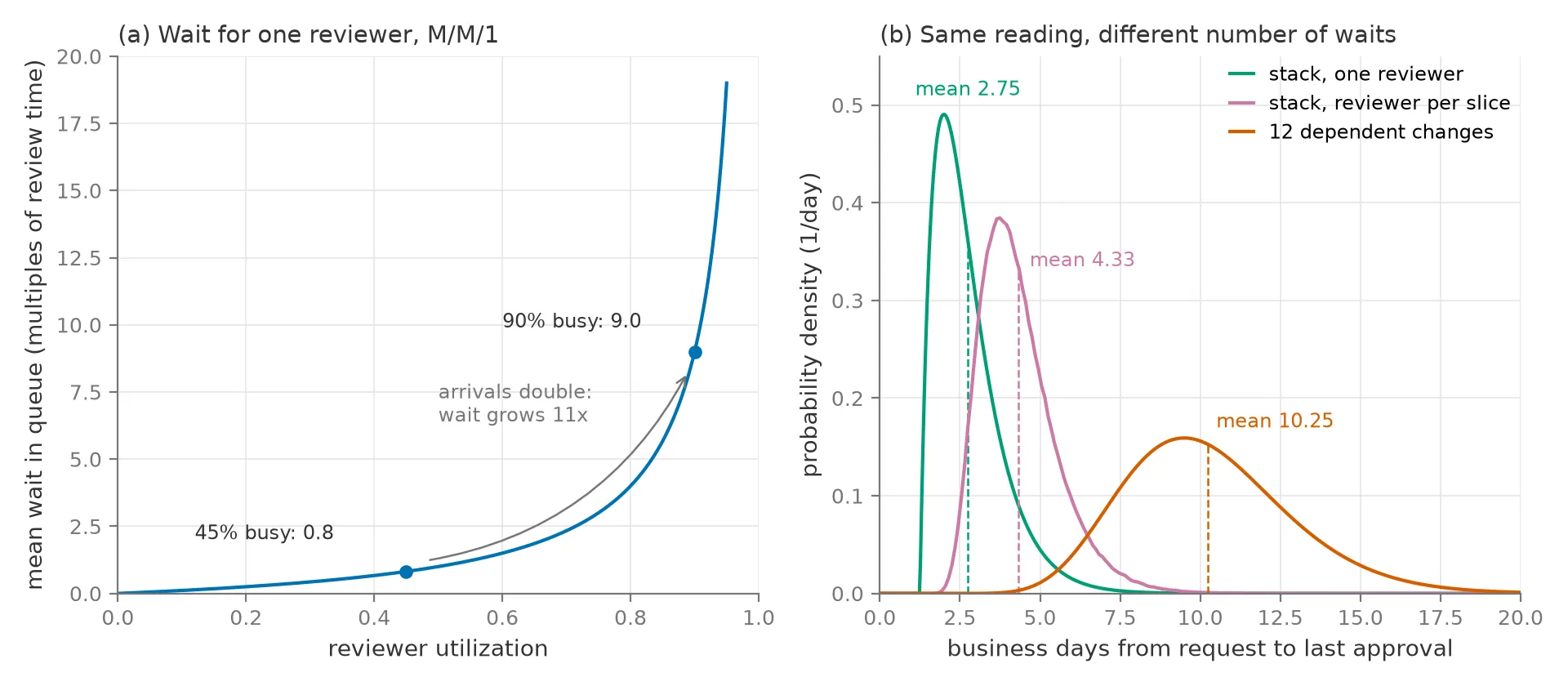
Figure 1. (a) Mean wait before review starts, in multiples of the mean review time, for one reviewer (M/M/1: Poisson arrivals, exponential review times, first in, first out). Doubling arrivals from 45% to 90% utilization raises the wait 11-fold. (b) Business days from first request to last approval for a 4,000-line package, with each queue wait exponential with a 0.75-day mean and 10 hours of reading in all three cases. Both stack cases start with one wait for design approval. The one-reviewer stack then waits once more, and the stack with a reviewer per slice waits for the slowest of 12 parallel reviews.
The model is a sketch with stated limits. Real teams have several reviewers, who also write code and juggle priorities. Real arrivals are burstier than a Poisson process, because an agent can produce a dozen changes in one afternoon. Kingman’s approximation for a general single-server queue multiplies the M/M/1 wait by (ca² + cs²)/2, where ca and cs are the coefficients of variation of the interarrival and review times. The factor is 1 for the M/M/1 case and grows as either becomes more variable (Kingman, 1961). Bursty agent output therefore pushes the wait up at any given utilization.
Review load in the 2025 and 2026 data
The rate at which changes arrive is rising. GitHub’s Octoverse report counts 1.3 billion merged pull requests (PRs) on the platform in 2026, more than triple the count two years earlier, and reports that developers started more than 40% of PRs with an agent in September 2026, up from 17% in March (GitHub Octoverse, October 2026). In the same report, 83% of agent-involved PRs merged within two weeks in February 2026 and 90% in September, against about 86% for PRs without a detected agent. That measure is coarse, GitHub counts only the agent use it can detect, and public repositories differ from a production codebase with required reviewers.
Two observational studies of teams show where the added volume lands. Telemetry from Faros AI, a vendor, found 98% more merged PRs, 154% larger PRs on average, and 91% longer PR review time at high AI adoption across 1,255 teams (Faros AI, July 2025). He and colleagues followed 802 developers and 196,212 PRs at one company from January 2024 to April 2026, after its chief technology officer set a target of doubling merged PRs per engineer (preprint, arXiv 2607.01904). Throughput per developer reached 2.09 times the earlier level and load per reviewer roughly doubled, while revert rates stayed flat. After the mandate, AI-authored PRs took about 20% longer from first human review to merge, and the authors treat their estimates as an upper bound for other companies.
Developers describe the same load in surveys. In a study titled “Level Up!”, Newman, Bird, Butler, and Murphy-Hill interviewed 24 developers and surveyed 2,590 at one large multinational software company in mid-2026 (preprint, arXiv 2611.18939). Among the respondents shown each item, 56% felt more mentally drained by review than before, and 62% said their review interactions with authors feel less like mentoring opportunities. Using AI for review was not correlated with less difficulty keeping up with PR volume, and personally using it was correlated with more difficulty, with a small effect (r = .16). The strategies developers rated most useful were “organizations supporting and resourcing review, pushing review burden upstream, and prioritizing reviewer attention on the concerns that matter most.”
Whether reviewers loosen their standards under that load is contested. In “Habituation at the Gate,” Yu and colleagues followed 400 reviewers of agent-authored PRs in public repositories through 11,429 reviews over seven months. Approval rates rose from 30.1% to 36.8%, inline comments fell 22%, and review latency rose 3.5-fold, which the authors read as reviewers spending “more time in queue but less time actively inspecting code” (preprint, arXiv 2606.22721). They “lack a direct measure of agent code quality over time,” so improving agents could explain the rise. Hamza and colleagues found reviews becoming “faster, less detailed, and more permissive” both in agent-using repositories and among 228 control developers, which points to a broader trend in how open-source PRs are reviewed (Hamza et al., 2026).
Review time also depends on where AI-written code lands. In about 400,000 diffs from more than 10,000 developers at Meta, Mockus and colleagues found shorter review times and fewer production outages for diffs with AI code. AI code also landed more often in less central code and test files, and “both associations are confounded by AI code appearing in less central contexts” (Mockus et al., 2026). Review cost appears to depend on where code sits in the system more than on who wrote it, which is the premise of the risk-based practices below.
What AI review adds, and where it shares the author’s blind spots
AI reviewers produce comments that authors act on. OpenAI reports that every internal PR is reviewed automatically and that authors respond to its reviewer’s comments with a code change in 52.7% of cases, a rate it reached by optimizing “signal-to-noise first” and recall second (OpenAI, December 2025). The figure comes from the company that built the tool. An addressed comment shows that a finding was useful, and the rate says nothing about the defects a reviewer missed.
The commercial tools stop short of approval by default. Claude Code’s documentation states that “a review never approves or blocks the pull request” (Claude Code docs). GitHub’s Copilot code review can approve in a public preview announced in September 2026. The ability is off by default, and once an admin enables it, its approval “counts toward the repository’s required-approvals rule” (GitHub changelog). Meta’s in-house Risk Aware Diff Auto Review (RADAR) system, described below, goes further.
The harder limit is shared assumptions. In January 2026 I used Claude Code to convert a research notebook into a 4,398-line Python package with 72 test functions in about a day of commits (earlier post). A unit test written during the rewrite asserted that a 6 dBi element (gain in decibels relative to an isotropic radiator) scaled the pattern by 106/10, the power ratio the prototype had wrongly applied to a field quantity. The test confirmed that the code agreed with itself, and the error survived my tests and review for eight months until an outside contributor found it. An AI reviewer that reads the same code and tests can inherit the same convention, while a test against an independent reference, the closed-form cosine element at −3 dB at 60°, would have failed. Simon Willison states the matching rule for authors: a test that proves a change works “should fail if you revert the implementation” (Willison, December 2025).
Practices that shorten the wait
Each practice below acts on one term of the model: the number of serial waits, the reading per review, or the reviewer’s utilization. Each has a cost, stated with it.
Approve the design before generating the code
A one-page design covering the problem, public interfaces, invariants, failure modes, and the evidence that will show the code is correct costs one wait and a short read. A design objection raised at change 9 of 12 costs the eight changes before it. Microsoft engineers apply the same idea to large code migrations, where experts “approve the knowledge base rather than individual fixes, and agents apply it across the codebase” (Microsoft Command Line, October 2026). The cost is specification overhead and the risk of fixing a design too early. Birgitta Böckeler, after trying spec-driven tools on a small bug, wrote “I’d rather review code than all these markdown files” (martinfowler.com, October 2025), and exploratory work still needs a prototype before the design is written down.
Generate the stack, then post it whole
Ask the agent for a dependency-ordered plan before it writes code: interfaces and data types, core logic, integration and error handling, then instrumentation. Commit each slice with its own tests, so the split follows the design and needs no surgery afterward. Post all the slices at once as a stack, so a reviewer can read them in order across scheduled sessions without each slice waiting in the queue separately, though each slice still needs its own approval. GitHub made stacked pull requests generally available on October 6, 2026, and reports a 9% increase in merged code for repositories using stacks compared with peers, and a 5% improvement in time-to-merge among the top 1% of repositories (GitHub changelog).
Those are vendor figures without a controlled comparison, and I found no controlled study of review latency for stacks against single large PRs. The costs fall on the reviewer and the queue. Someone has to schedule 10 to 20 hours of reading, and that one large job delays every other change in the reviewer’s queue, which Kingman’s formula captures as higher variability in review times. A change requested in an early slice can also ripple through the later ones, and each regenerated slice needs reading again.
Bring the evidence with the change
Before asking a person, the author should run the checks a person would otherwise ask for: tests
against independent references, static analysis, and an AI review pass such as /code-review. A
short note on intent, risk, and verification lets the reviewer spend attention where the author is
least sure. The author also has to understand every line. Ghostty’s contribution policy says “If you
can’t explain what your changes do and how they interact with the greater system without the aid of
AI tools, do not contribute to this project”
(Ghostty AI policy). The cost is
author time, and AI review adds false positives that the author has to sort out.
Delete before asking for review
Review time scales with lines, and agents write more of them, as Faros AI’s 154% increase in average PR size shows. Asking the agent to remove unused code, duplicated helpers, and abstractions with a single caller before the stack goes out lowers the reading term for every reviewer who sees it. I know of no measurement of how much such a pass saves, so this practice rests on the reading-rate arithmetic above. The cost is an extra agent pass and a full test run, and a deletion that removes a path something still calls is a new defect.
Match review depth to risk
Ship/Show/Ask, described by Rouan Wilsenach in 2021, sorts changes into Ship (“merge into mainline without review”), Show (“open a pull request for review, but merge into mainline immediately”), and Ask (“open a pull request for discussion before merging”) (martinfowler.com, 2021). Risk depends on blast radius, reversibility, and exposure more than on line count, and a one-line change to an authorization check can matter more than 1,000 lines of documentation. The tiers need a policy that someone owns.
Meta has automated part of that sorting. Its RADAR system, described in a 2026 preprint by Meta engineers, checks each diff against eligibility rules, a machine-learned Diff Risk Score, a review by a large language model, and deterministic validation, and some diffs that pass land with “no human review” (Adams et al., arXiv 2605.30208). The authors report more than 535,000 diffs reviewed this way, more than 331,000 landed, and a median review wall time 35% shorter than for human-reviewed diffs. Reverts and production incidents were rarer than for other diffs, though “diffs are not randomly assigned to RADAR,” so the lower rates partly reflect which diffs qualified. Any classifier will misjudge some changes, so changes to authentication, data integrity, concurrency, and safety controls should keep full human review.
My personal packages sit in the lowest tier by these criteria, and that placement is a risk I accept. A wrong result costs a patch release, users can pin an earlier version, and the code is public, which is how an outside reader found the dB error. That error still shipped for eight months, and anyone who used those versions got the wrong element gain until the fix. A production service with many dependents sits in a higher tier, and part of its two-week review is protection it needs.
Budget reviewer capacity
The utilization curve leaves two ways to cut the wait: add review capacity or reduce arrivals. Google developers spent a median of 2.6 hours a week reviewing in Sadowski’s 2018 study, and agent output raises the hours a team needs without raising the hours it has unless someone plans for it. At that median, the 10 to 20 hours of reading in one 4,000-line package equal 3.8 to 7.7 weeks of one reviewer’s review time, so a package like mine has to spread across several reviewers or displace other reviews. Treating review as scheduled work with counted hours is the organizational support the Level Up! respondents rated most useful. The cost is direct: review hours come out of the same engineers’ feature work.
A team that measures queue wait separately from active review time can tell which problem it has. The pattern Yu and colleagues found, longer latency with fewer inline comments, would be invisible in a single cycle-time number. Tracking reverts and escaped defects alongside both measures shows whether faster approvals came from weaker review.
What not to shortcut
Knowledge transfer requires people to read code, and 62% of the Level Up! respondents shown that item already report fewer mentoring moments in review. High-consequence changes need domain-expert review regardless of who wrote them, and stronger evidence there (property-based tests, fault injection, formal methods where justified) adds friction on purpose. Approval habits also need watching. An approval that reviewers give by reflex adds latency without adding assurance, the same pattern my post on reviewing agentic systems describes for agent permission prompts.
Summary
Reading a 4,000-line package at 200 to 400 lines per hour takes 10 to 20 hours, a fraction of the roughly 80 working hours in two weeks. Split into 12 dependent changes that each wait 0.75 business days on average, the package takes about 10.25 business days from first request to last approval in the model. After one design approval and one stack, the same package takes about 2.75 days with one reviewer and 4.33 with a reviewer per slice. Doubling arrivals at a reviewer who was 45% busy multiplies the M/M/1 wait by 11 and the number of waiting changes by 22. The 2025 and 2026 data are mixed: load per reviewer doubled at one company that mandated AI use, agent-started PRs on GitHub merged within two weeks slightly more often than others, and AI code at Meta was reviewed faster largely because it landed in less central code. The practices that help reduce the number of waits, the reading per wait, and the utilization, and they matter most where changes are consequential and reviewers are already busy.
This is an independent analysis I did on my own time, using the public sources cited above. The views are my own and do not represent any current or former employer.
Frequently asked questions
Why can AI-generated code take weeks to get through code review?
In a simple queueing model, most of the time is queue wait. Reading a 4,000-line package at 200 to 400 lines per hour takes 10 to 20 hours. Split into 12 dependent changes, the package waits in a reviewer's queue 12 times, and at 0.75 business days per wait that adds 9 business days. If agents double the arrival rate at a reviewer who was 45% busy, the M/M/1 queueing model puts the mean wait 11 times higher. In some settings agent-written code moves faster: on GitHub in September 2026, agent-started pull requests merged within two weeks slightly more often than others.
Does AI code review fix the review bottleneck?
AI review produces findings that authors act on: OpenAI reports code changes after 52.7% of its AI reviewer's comments. It has not been shown to ease the volume problem. In a 2026 survey of 2,590 developers at one large company (a preprint), using AI for review was not correlated with less difficulty keeping up with pull request volume.
Should an agent's output go into one large pull request?
Keep the changes small. Google's review guide calls 100 lines usually reasonable and 1,000 lines usually too large. To shorten the wait, approve a one-page design first, generate the slices in dependency order with their tests, and post them together as a stack. With one reviewer reading the whole stack, the series waits twice instead of 12 times. With a different reviewer for each slice, it finishes when the slowest review does, which for 12 exponential waits averages about 3.1 waits.
Can an AI reviewer approve a pull request?
Claude Code's Code Review never approves or blocks a pull request. GitHub Copilot code review can approve in a public preview announced in September 2026. The setting is off by default, and when an admin enables it, Copilot's approval counts toward the repository's required-approvals rule. Inside Meta, a system called RADAR, described in a 2026 preprint, lets some low-risk diffs land with no human review after they pass eligibility rules, a risk score, a review by a large language model, and deterministic checks.