Programming the aperture: my PhD research on reconfigurable intelligent metasurfaces
A conventional radio spreads its work across a chain of hardware: a source generates the signal, mixers move it to the carrier frequency, phase shifters and amplifiers condition it, and the antenna finally launches it. My PhD research started from a different question: what happens when the aperture itself becomes a programmable part of the transceiver?
At Virginia Tech I worked on reconfigurable intelligent metasurfaces (in the communications literature, reconfigurable intelligent surfaces, or RIS): electrically thin arrays of subwavelength elements whose electromagnetic response can be changed electronically. Programmed well, such a surface can steer an incident wave, reshape it, change its polarization, generate new frequencies from it, or imprint data directly onto it. The dissertation, Reconfigurable Intelligent Metasurfaces for Wireless Communication and Sensing Applications, pulled together three threads: using the surface as a modulator, building and measuring real hardware, and using generative deep learning for inverse electromagnetic design. The defense slides are public along with my other electromagnetics work samples. This post is the informal version: what the research tried to do, what we built, and what carried forward.
What makes a metasurface programmable
A metasurface is a two-dimensional array of small scatterers, called meta-atoms, each designed to impose a chosen change on the amplitude, phase, or polarization of an incident field. A passive surface has its response fixed at fabrication. A reconfigurable one embeds controllable components, typically PIN or varactor diodes, inside each meta-atom; changing bias voltages changes the surface impedance and therefore what each element does to the wave. A spatial phase gradient steers a beam. Independently controlled regions form several beams. States that change in time do something stranger, which is where the modulation work begins.
Much of the early RIS literature treated the surface as an ideal matrix of adjustable phase shifts. My research lived in the physical layer beneath that abstraction: finite phase range, amplitude loss, quantization, bias routing, element geometry, coupling, and full-wave behavior. The recurring question was whether a specific, buildable surface could produce the fields the communications model assumed.
The surface becomes the modulator
One thread of the dissertation was index modulation: encoding bits in which resource is active (a beam direction, a frequency, a channel state) on top of whatever symbols the carrier already carries. A programmable surface offers many such indices. Spatially, the controller picks which beam or sub-aperture is on, and the choice itself carries information. Temporally, a meta-atom whose reflection phase varies periodically generates harmonics around the incident carrier, and the phase-code slope selects which harmonic gets the energy. The surface ends up doing work normally assigned to a mixer and a modulator, with no RF chain behind it.
That work appeared in Intelligent Time-Varying Metasurface Transceiver for Index Modulation in 6G Wireless Networks (IEEE Antennas and Wireless Propagation Letters, 2020) and grew into the most complete statement of the thread, Index-Modulated Metasurface Transceiver Design Using Reconfigurable Intelligent Surfaces for 6G Wireless Networks (IEEE Journal of Selected Topics in Signal Processing, 2023), co-first-authored with Kumar Vijay Mishra. I wrote a full plain-language explainer of this mechanism in The antenna is the modulator: index modulation with reconfigurable metasurfaces, so here I will leave it at the one-sentence version: the antenna stops being the last passive component in the chain and starts being where the modulation happens.
Building the two-bit prototype
Simulation happily assigns every meta-atom an arbitrary complex reflection coefficient. Hardware negotiates. The hardware thread of the dissertation produced a fabricated 128-element programmable metasurface in a reflectarray configuration: a 16-by-8 aperture designed for 6 GHz, with two-bit control giving each element four phase states (0, 90, 180, 270 degrees) through PIN diodes, at an average reflection loss of 0.34 dB in simulation. Each meta-atom column is driven by two digital control signals. The design was published as A Reconfigurable Intelligent Surface Using a 2-Bit Programmable Metasurface for Communications (IEEE AP-S, 2021).
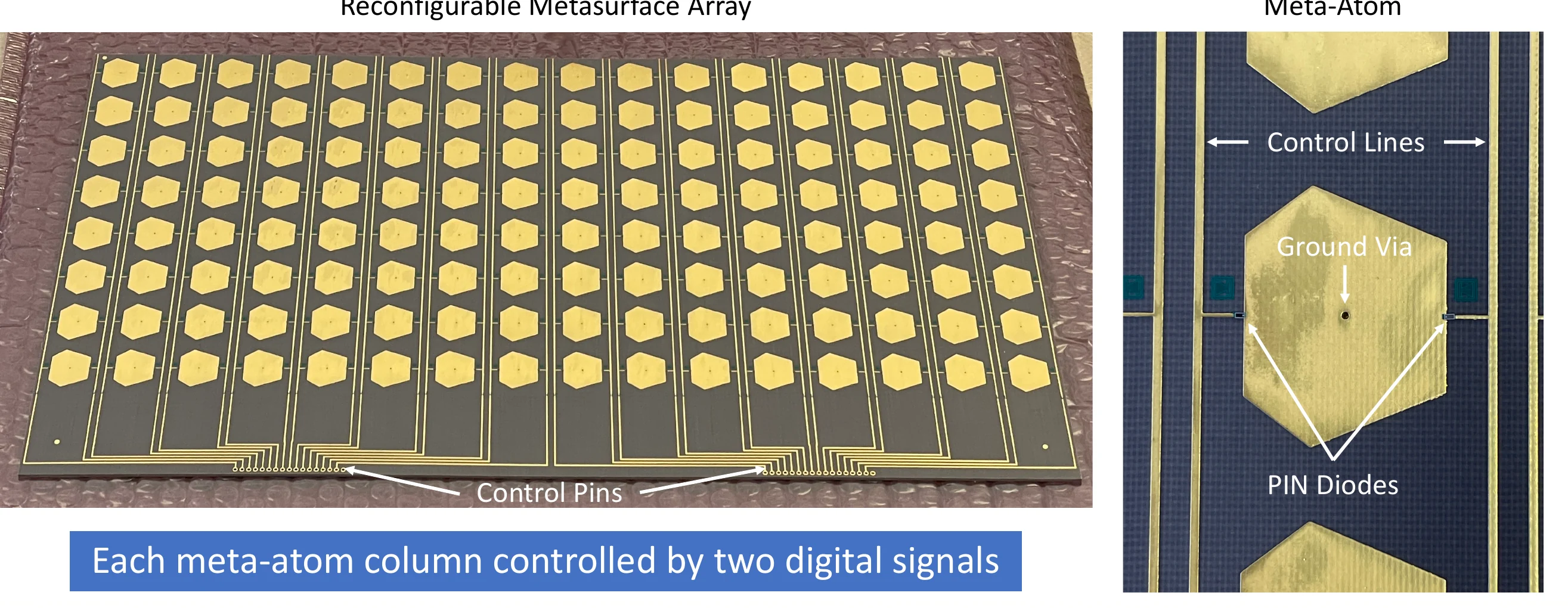
The fabricated board and a single meta-atom, from the defense slides. Hexagonal patches, two PIN diodes per element, and column-level bias routing: the parts of a programmable surface that an ideal phase matrix hides.
The project ran the whole loop: meta-atom design and simulation, aperture and bias-network layout, board fabrication and assembly, reflection measurements on a network analyzer, and radiation-pattern measurements in a tapered anechoic range in center-fed and offset-fed configurations. The measured board worked, and it also taught. The resonance landed 1.3% low, at 5.92 GHz. The beamforming controller had to compensate for the spatial phase delay of the feed before any textbook steering command meant anything. Measured patterns demonstrated dynamic steering across the scan volume (including a run steered to +20 degrees azimuth) and dynamic phase modulation in the offset-fed setup, all at the shifted frequency rather than the designed one.
None of that is a complaint about the board. It is the content of the phrase “programmable phase shift” once you build one: calibration, tolerance-aware design, bias routing, and control electronics are where most of the engineering lives. The measured aperture, with its shifted frequency and column-level control granularity, is the device you actually get to program.
Generative deep learning for inverse design
The third thread attacked a different bottleneck. Metasurface design means searching over geometry, materials, and component states, and each candidate evaluation can cost a full-wave simulation. A broad optimization burns thousands of solver runs.
We investigated whether generative models could learn the relationship between a metasurface’s structure and its electromagnetic response, then run it backward: start from a desired response and generate candidate structures. That produced a series of papers on deep convolutional GANs for RF metasurfaces, including multilayer and tensorial structures, and an overview, Deep Inverse Design of Reconfigurable Metasurfaces for Future Communications. The models never made Maxwell’s equations optional. They trained on simulation data, and every generated design went back to the solver for verification; the change was economic, spending expensive full-wave runs on promising candidates instead of on a blind search. That division of labor, learned model proposes and physics verifies, is the same one I now consider table stakes in scientific machine learning.
The publications
The communications and programmable-surface thread: Reconfigurable Metasurfaces for Index Modulation in 5G Wireless Communications (ACES, 2019); Intelligent Time-Varying Metasurface Transceiver for Index Modulation in 6G Wireless Networks (IEEE AWPL, 2020); A Reconfigurable Intelligent Surface Using a 2-Bit Programmable Metasurface for Communications (IEEE AP-S, 2021); and Index-Modulated Metasurface Transceiver Design Using Reconfigurable Intelligent Surfaces for 6G Wireless Networks (IEEE JSTSP, 2023).
The deep-learning design thread: RF Metasurface Array Design Using Deep Convolutional Generative Adversarial Networks (IEEE PAST, 2019); Multi-Discriminator Distributed Generative Model for Multi-Layer RF Metasurface Discovery (IEEE GlobalSIP, 2019); Joint Multi-Layer GAN-Based Design of Tensorial RF Metasurfaces (IEEE MLSP, 2019); and the inverse-design overview above.
Three of these picked up student-paper awards (second place at ACES 2019, third at IEEE MLSP 2019, and an honorable mention at IEEE AP-S 2021). My research page has the full list with links, and Google Scholar has current citation data.
From the research to software
The lesson the prototype taught, that the implemented aperture rather than the ideal phase matrix determines what a surface can do, eventually became software. I maintain metasurface-py, an open-source Python toolkit for modeling and optimizing programmable surfaces with exactly those hardware effects (quantized phase states, grouped control lines, failed elements, manufacturing variation) as first-class citizens. I wrote about it separately in metasurface-py: a Python toolkit for programmable electromagnetic surfaces.
The throughline across all of it has stayed stable: start from the fields and the physical aperture, connect them to the system objective, model the nonidealities instead of assuming them away, use optimization or learning to explore the space, and return to full-wave simulation or measurement to find out whether the result is real. OpenEM Wave Lab is the foundations layer of that story, model-based engineering for phased arrays is the systems layer, and the index-modulation explainer is the deep dive on this dissertation’s central trick.
My doctorate was supported financially by Northrop Grumman. The research owes a debt to many people: my advisor and committee chair, Prof. Amir Zaghloul, and my committee, Profs. Majid Manteghi, Wayne Scales, Lamine Mili, and Xiaoyu Zheng, and Dr. Thomas Spence; mentors and collaborators at the U.S. Army Research Laboratory, Dr. Kumar Vijay Mishra, Dr. Steve Weiss, and Theodore Anthony; and my mentors at Northrop Grumman, among them Dr. Spence, Dr. Eric Holzman, and Dr. Arik Brown, and many others. Thank you.
This is an independent write-up of published academic research. The views are my own and do not represent any current or former employer.
Frequently asked questions
What is a reconfigurable intelligent metasurface?
An electrically thin array of subwavelength elements (meta-atoms) whose electromagnetic response can be changed electronically, usually by biasing diodes embedded in each element. Programming the amplitude and phase response across the array lets the surface steer, focus, or modulate an incident wave without a conventional RF chain behind every element.
How is a metasurface different from a phased array?
An active phased array puts a full transmit or receive chain, with amplifiers and phase shifters, behind its elements. A reflectarray or reconfigurable intelligent surface reshapes a wave supplied by a separate feed, so it needs far less RF hardware per element. The tradeoff is its own set of losses, illumination constraints, bias-network complexity, and calibration work.
Did the neural networks replace electromagnetic simulation?
No. The generative models learned from data produced by full-wave electromagnetic simulations and proposed candidate structures for a desired response. Every generated design still needed physics-based verification; the value was using the expensive solver to check promising candidates instead of searching the whole design space with it.